The stock photography and illustration industry is a global market where millions of transactions occur daily. For photographers, graphic designers, and illustrators, stock photos (or microstocks) are not just an additional source of income, but a full-fledged tool for creating passive income and scaling their creativity. The resource bur4ik.ru has prepared the most detailed guide to help authors of any level understand the mechanics of stock, choose the right platforms, and optimize their content for maximum profit.
Stock Photos: Your First Step to Monetizing Photography
Stock photos are online platforms that act as intermediaries between creators of visual content (contributors) and buyers (companies, designers, marketers). The microstock operating model is based on selling the same work an unlimited number of times at a relatively low price. This is what provides the potential for passive income.
The main advantage of working with stock sites is the ability to turn an already created archive of works into a stable cash flow. However, to achieve success, you need to understand how this market functions and what requirements it imposes on content.
Key Concepts in the World of Stock:
- Contributor: An author who uploads their works to a stock site.
- Royalty: The percentage of sales that the author receives. On microstocks, it usually ranges from 20% to 60%.
- License: Permission to use content. Most commonly used are Standard License and Extended License (which grants rights for larger print runs or use in goods for resale).
- Portfolio: The total number of accepted and available works by an author. The more quality works in a portfolio, the higher the potential earnings.
Top 10 Most Profitable Stock Photo Sites for Beginners and Professionals

Choosing the right platform is a critical step. Some stock sites have a high entry barrier and strict requirements, while others are more lenient with beginners. Experts recommend starting with 3–5 of the largest platforms to maximize market coverage.
Essential Platforms (Market Giants):
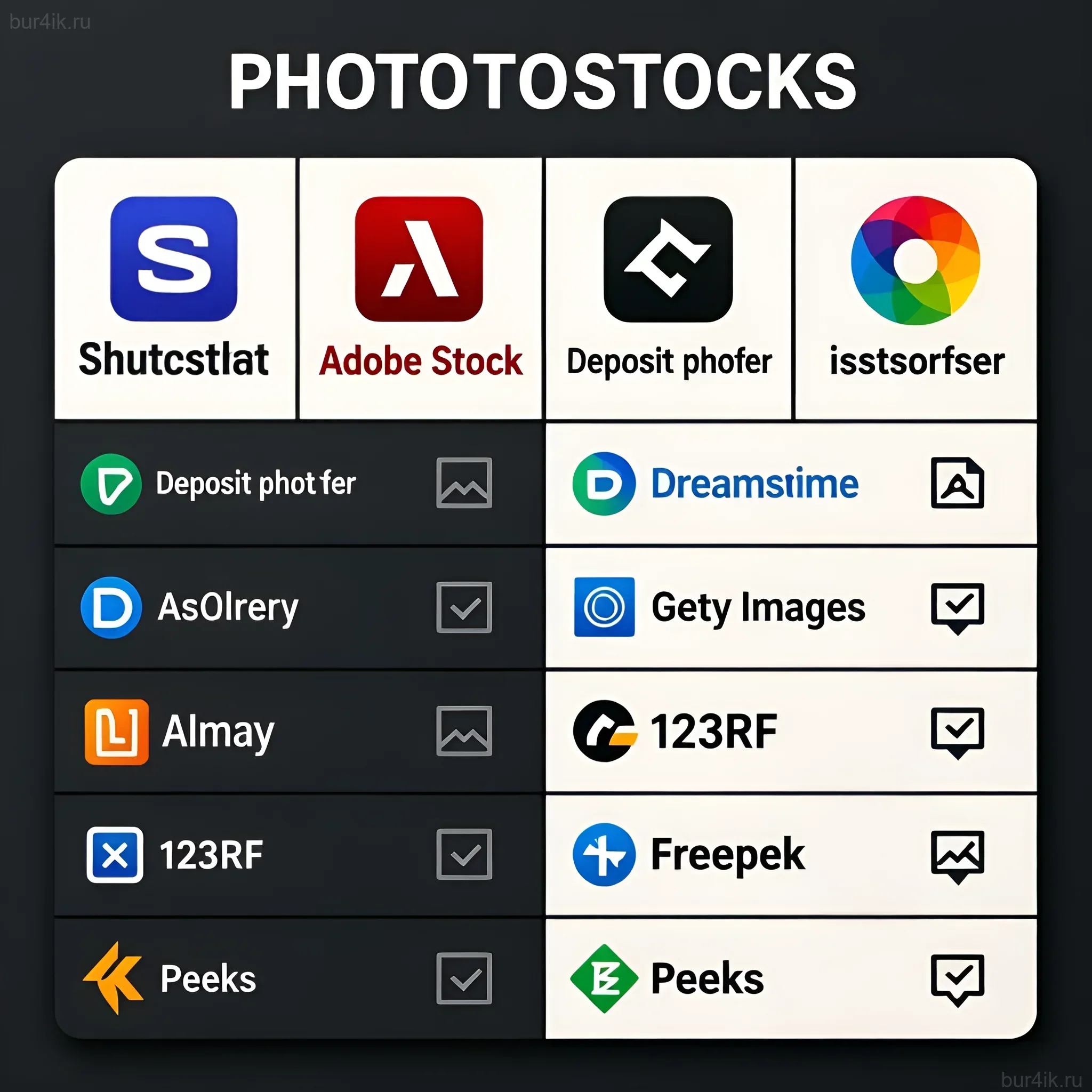
- 1. Shutterstock: Has long been the market leader. It has the largest buyer audience and a huge sales volume. It’s ideal for starting, although the royalty percentage for beginners is not high.
- 2. Adobe Stock: Integrated into the Adobe Creative Cloud ecosystem (Photoshop, Illustrator), which provides it with a colossal influx of buyers. It has one of the highest average sale prices.
- 3. Getty Images/iStock: Premium segment. Getty Images works with large corporate clients, while iStock is a more accessible microstock. The quality and exclusivity requirements here are higher.
Stock Sites for Stable Income and Diversification:
- 4. Dreamstime: A good choice for beginners. It has more lenient moderation and offers a high royalty percentage for exclusive works.
- 5. Depositphotos: Popular in the European and Eastern European markets. It features a user-friendly interface and fast moderation.
- 6. 123RF: A major player with a good reputation. Suitable for those who want to maximize their sales geography.
Niche and Emerging Platforms:
- 7. Bigstock Photo: Owned by Shutterstock but has its own audience. It can provide additional, albeit small, income.
- 8. Alamy: Known for accepting a wide range of photos, including niche and editorial shots. The royalty percentage is very high (up to 50%), but the sales volume is lower than that of the giants.
- 9. Freepik (for illustrators and designers): Although Freepik often works on a subscription basis, its author payment model through premium downloads is very profitable, especially for vector graphics.
- 10. Pexels/Unsplash (conditionally): These platforms provide content for free but can be used to increase author recognition or as a source of referral traffic if you plan to sell your content on other platforms or directly. Important: they are not direct sources of income, but rather marketing tools.
What Sells on Stock Photo Sites: In-Demand Themes and Niches
The mistake of many beginner authors is uploading “beautiful” photos that have no commercial value. Buyers on stock sites are marketers and designers who need content to solve specific business problems. Experts at bur4ik.ru highlight several of the most profitable and in-demand niches.
Evergreen Themes:
- Business and Finance: Meetings, teamwork, remote work, startups, charts, handshakes. Important: avoid clichés; look for modern and inclusive imagery.
- Health and Well-being: Healthy eating, sports, yoga, medicine (with an emphasis on prevention, not illness).
- Family and Relationships: Realistic, unposed life scenes. Diversity of ethnic groups and ages.
- Technology and IT: Using gadgets, cybersecurity, artificial intelligence, VR/AR.
- Food and Drinks: Not just beautiful dishes, but ingredients, the cooking process, and a healthy lifestyle.
Trending Niches for 2024–2025:
- Sustainability and Ecology: Waste sorting, renewable energy sources, responsible consumption.
- Flexible Schedule and “Work from Anywhere”: People working in cafes, parks, at home, work-life balance.
- Conceptual Abstractions: Modern minimalist backgrounds, gradients, geometric patterns (illustrations are especially in demand).
Expert Tip: Always shoot with “empty” space (negative space) where a designer can insert text or a logo. This significantly increases the commercial appeal of the shot.
Technical Requirements for Stock Photos: How to Pass Quality Control

Moderation on stock sites is very strict. Rejection of work due to technical deficiencies is the most common reason for beginners’ failures. To avoid this, you need to adhere to basic standards.
Basic Technical Criteria:
1. Resolution and Size:
- Minimum size: Most stock sites require at least 4 megapixels (MP). It is recommended to upload shots with a resolution of 6000×4000 pixels (24 MP) and higher.
- Format: JPEG for photos (with minimal compression) and EPS/AI for vector graphics.
2. Focus and Sharpness:
- The image must be absolutely sharp at key points. Check sharpness at 100% zoom.
- Any focus error (motion blur or front/back focus) leads to rejection.
3. Noise and Artifacts:
- Avoid high ISO. Digital noise, especially in shadows, is a common reason for rejection.
- Chromatic aberrations (colored halos on high-contrast edges) must be corrected in post-processing.
4. Exposure and Post-Processing:
- Shots should not be overexposed (blown highlights) or underexposed (crushed shadows).
- Excessive retouching, filters, or HDR effects that look unnatural are usually rejected. The photo should look professional but realistic.
Table: Common Reasons for Content Rejection
| Error Category | Description | How to Avoid |
|---|---|---|
| Technical Quality | Noise, lack of sharpness, compression artifacts. | Shoot at low ISO, check sharpness at 100%. |
| Legal Issues | Visible logos, trademarks, recognizable buildings (without PR). | Retouch/remove logos, obtain releases. |
| Composition/Lighting | Poor lighting, lack of commercial value. | Shoot in good natural light, study trends. |
Keywords and Tags: How to Make Your Photos Stand Out

SEO (Search Engine Optimization) is not just for websites. On stock sites, proper indexing (keywording) is the main factor for success. An excellent photograph, poorly described, will never sell.
Effective Keywording Strategy:
1. Title:
- Should be concise, accurate, and contain the 2–3 most important keywords.
- BAD example: “Girl in a park.”
- GOOD example: “Young woman using a laptop in a green park, remote work.”
2. Description:
- A more detailed sentence describing the plot, emotions, location, and intended use of the shot.
- Use synonyms of the keywords from the title.
3. Keywords/Tags:
- Quantity: It is optimal to use 30 to 50 tags. Less than 20 is insufficient, more than 50 is often ineffective.
- Relevance: Always start with the most relevant and specific tags (e.g., “Asian woman, laughing, holding coffee”).
- Synonyms: Include synonyms (e.g., “happiness, joy, smile, positivity”).
- Conceptual Tags: Add tags describing the concept or emotion (“goal, success, strategy, motivation, balance”).
- Using Tools: Many stock sites (especially Shutterstock and Adobe Stock) offer tools for automatic tag selection. Use them, but always check for relevance.
Important Note: Never use tags that are irrelevant to the shot in an attempt to attract more traffic. This is called keyword spamming and can lead to account suspension.
Legal Aspects: Models, Releases, and Copyright on Stock Sites

Legal clarity of content is what distinguishes a professional stock photographer. Working with models, recognizable objects, and private property requires the preparation of special documents.
Model Release (MR):
This is a legal document signed by the person depicted in the photograph, granting permission for the commercial use of their image. If a person’s face is recognizable in the shot, a Model Release is mandatory for sale under a commercial license.
Property Release (PR):
Required if the shot depicts recognizable private property, works of art, interiors, or contemporary architectural structures protected by copyright (e.g., some museums, private homes, sculptures). A PR is signed by the owner of that property.
Editorial Use Only:
If you cannot obtain an MR or PR (e.g., when photographing street protests, public events, or famous buildings), you can upload the shot marked “Editorial Use Only.” Such content can only be used to illustrate news articles, educational materials, or documentation, but cannot be used in advertising.
Copyright and Intellectual Property:
- Logos and Brands: All recognizable logos, trademarks, and brand names must be removed or retouched. Otherwise, the shot may only be accepted as Editorial.
- Screenshots: Screenshots of software (especially Apple or Microsoft) often require permission from the copyright holder.
- Your Right: By uploading a work to a stock site, you are selling a license for its use, but the copyright remains with you.
FAQ: Answers to the Most Popular Questions About Earning from Stock Photos
Beginners often face the same questions. bur4ik.ru experts have compiled answers to the most relevant ones.
1. How much can you earn from stock photos?
Earnings vary greatly. In the first few months, with a small portfolio (up to 100 works), income can range from $5–$50 per month. With a portfolio of 1000–3000 works optimized for trends, income can reach $500–$2000 and more. This is a long-term investment: the more quality content you upload, the higher the income.
2. Can I upload the same photo to different stock sites?
Yes, this is called non-exclusive distribution. It is a standard and recommended strategy to maximize profits. However, some stock sites (e.g., Getty Images) offer higher royalties for exclusive cooperation.
3. What should a beginner start with if they don’t have a professional camera?
Modern smartphones (especially flagship models) can take photos that meet the minimum technical requirements of stock sites (4–6 MP). The key is good lighting, no noise, and a commercial idea. Vector illustration and 3D graphics do not depend on a camera at all.
4. How often should I upload new content?
Consistency is key to success. It is recommended to upload content regularly (at least 20–50 new works monthly) so that stock site algorithms see your activity and promote your works in search results.
5. Illustrations or photos: which is more profitable?
Both directions are profitable. Photography requires less time to create a single piece of content, but competition is higher. Illustration (especially vector graphics) requires more time to create but has a higher average price and less competition in the niche.
Interesting Facts About Stock Photos: Statistics, Trends, and Prospects
The stock content market is constantly evolving, responding to changes in design, technology, and the global economy.
- Video Content: Stock video (footage) sales are growing faster than photo sales. The average sale price of a video clip is 5–10 times higher than that of a static image.
- Trend towards Authenticity: Buyers are increasingly looking for “real life” rather than glossy staged scenes. Photos taken against natural, rather than studio, backdrops are gaining popularity.
- Impact of AI: Artificial intelligence (AI) is already integrated into the moderation and keywording process. However, generative AI has not yet replaced authors, but rather created a new niche: stock sites are starting to accept images generated by neural networks, but with mandatory labeling. This opens up new prospects for illustrators.
- Mobile Stock: Specialized platforms are emerging that focus exclusively on content shot on smartphones, democratizing the entry into stock photography.
Earning from stock photos is a marathon, not a sprint. It requires consistency, attention to detail, and the ability to analyze the market. By applying the principles outlined in this guide, any author can turn their hobby or professional skills into a reliable source of income.