Creating a photography book is an ambitious and multifaceted project that requires not only deep knowledge in the field of photographic art but also skills in structuring information, writing, and marketing. The portal bur4ik.ru presents a comprehensive guide that will help photographers, educators, and enthusiasts turn their experience into a printed (or digital) bestseller. This material covers all stages: from the birth of an idea to the successful promotion of the finished product.
Define Your Niche and Target Audience: How to Make a Photography Book in Demand
In a world oversaturated with information, a general book “How to Photograph” is doomed to be forgotten. Success lies in specialization. bur4ik.ru experts insist: before you write, you need to clearly define *for whom* and *about what* your work will be.
The Importance of Niche Focus:
- Books with a narrow focus sell better because they solve a specific, pressing problem for the reader.
- You position yourself as an indispensable expert in a particular field.
Examples of Successful Niche Directions:
- Technical: Deep dive into light management in the studio, mastery of working with a single type of lens (e.g., macro or fisheye).
- Genre-Specific: The art of black and white landscape, documentary street photography, fashion shoots using film cameras.
- Process-Oriented: Advanced post-processing in Capture One, creating photobooks for personal archives.
- Mobile: Secrets of mobile food photography for Instagram.
Defining Your Target Audience (TA):
Answer the question: at what level is your reader?
- Absolute Beginners: Require step-by-step instructions, minimal jargon.
- Hobbyists: Looking for ways to improve current results, master new techniques (e.g., time-lapse).
- Professionals: Interested in business aspects, complex technical nuances, or authorial vision.
Competitor Analysis and Self-Definition:
Before you start, study the bestsellers in your potential niche. What are they missing? Where are their explanations too superficial?
- What problem does my book solve? (e.g., “I have everything about landscapes, but no guide on shooting in bad weather.”)
- Who will it be useful for? (Only those with DSLR cameras? Or smartphone owners?)
- What makes my book unique? (Unique author experience, exclusive examples, specific humor.)
Structure Your Book: Create a Logical and Engaging Plan
A chaotic collection of knowledge is not a book, but scattered notes. Structure is the skeleton of your work, ensuring the reader’s smooth immersion into the material. A good structure guides the reader from basic concepts to complex techniques.
Principles of Logical Construction:
- From Simple to Complex: If it’s a textbook, start with the basics of exposure, then move on to composition, and only then to complex lighting schemes.
- Spiral Learning: Returning to previously studied topics at a new, deeper level.
Examples of Structures Depending on Book Type:
For a Textbook/Guide:
- Introduction: Introduction to the author and the book’s goals.
- Part I: Fundamentals (Technique, settings, terminology).
- Part II: Practice (Working with light, composition).
- Part III: Post-processing (Basic and advanced techniques).
- Conclusion: Further development and resources.
For an Inspirational Album with Commentary:
- Theme 1: Portrait in the city.
- Photograph + Detailed Analysis (Problem, Solution, Emotion).
- Theme 2: Shooting architecture at dusk.
- Photograph + Technical details.
Creating a Book “Map”:
Create a detailed table of contents before you start writing the main text. This is your navigation system.
- Chapters: Macro-themes.
- Subchapters: Specific sections within a chapter.
- Points: Individual theses or exercises.
Including Practice:
A photography book should be interactive. The reader should not only know but also *do*.
- Each chapter should end with one or two practical assignments (e.g., “Take a series of 10 portraits using only side light”).
- Include “Case Studies” where you analyze unsuccessful or, conversely, successful shoots with an explanation of why the result turned out that way.
Determining Volume:
Realistically assess how much information you want to include. A deep textbook will require at least 200-300 pages, while a niche guide to mobile photography might need 100-150 pages with an emphasis on the visual component.
Write the First Draft: Overcome the Fear of a Blank Page and Write Without Self-Criticism
The biggest mistake of novice authors is trying to write a perfect text on the first try. The first draft serves a single purpose: to transfer ideas from your head to paper (or screen). It should be raw, full of errors and imperfections.
Organizing Your Workflow:
- Time Planning: Allocate specific, inviolable hours for writing (e.g., 7:00 AM to 9:00 AM daily). It’s better to write for 30 minutes every day than 8 hours once a month.
- Comfortable Environment: Eliminate all distractions. Use social media blocking apps if necessary.
Methods for Combating Procrastination and Perfectionism:
- Freewriting: Start writing everything that comes to mind on the chapter’s topic without stopping to correct spelling or search for a better word. Flow is important.
- Pomodoro Technique: 25 minutes of intense work, 5 minutes of rest. This maintains concentration.
- The “Draft is Just a Draft” Principle: Forbid yourself from editing what you wrote 10 minutes ago. Editing only happens after completing the entire chapter or the entire draft.
Regularity and Discipline:
Discipline is more important than motivation. If you start treating writing a book as a job, not a hobby, progress will become inevitable.
- Set a minimum daily word count (e.g., 500 words).
- If you get stuck on a complex technical part, skip it and move on to a simpler chapter you know by heart.
How to “Hook” the Reader: Examples of Chapter Beginnings:
Start a chapter with a provocative question, an unexpected fact, or a strong personal story related to the topic.
- Instead of: “This chapter is about the aperture.”
- Try: “Every beginner thinks that to get beautiful bokeh, you need expensive optics. In reality, the key lies in controlling the depth of field, and you can master this by knowing just one simple formula…“
Speeding Up the Process:
If you speak quickly, use a voice recorder or speech-to-text software. Dictated material often sounds more lively and natural than typed material, and it’s easier to proofread later.

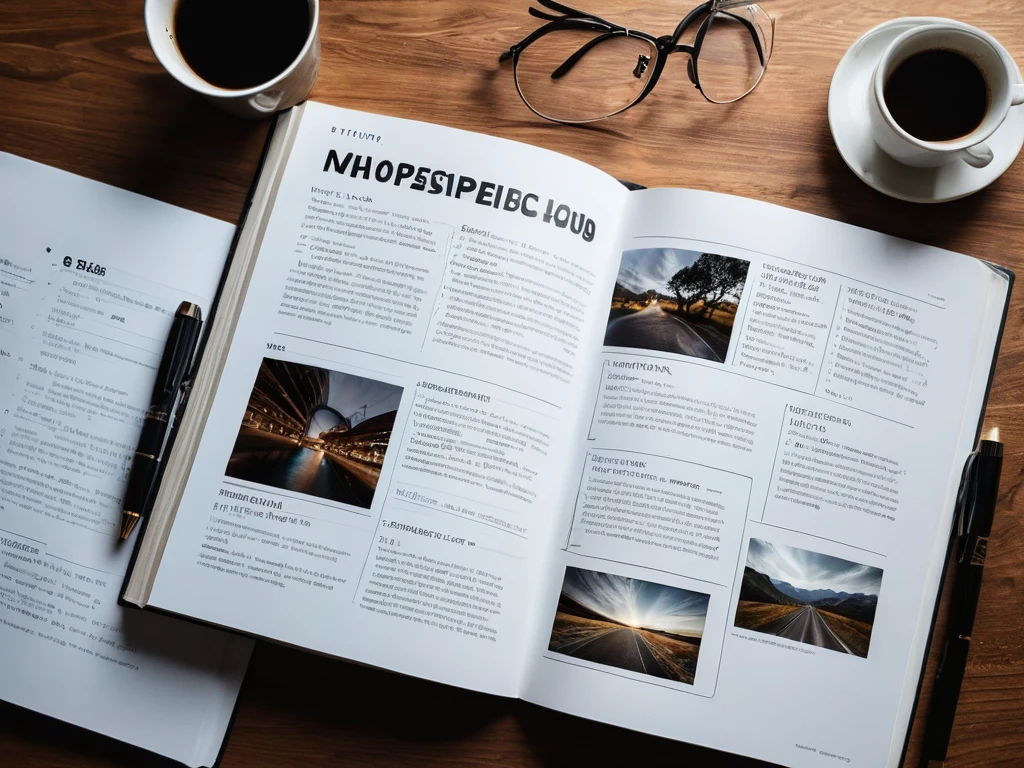
Illustrations and Examples: How to Visually Enhance Your Photography Book
A photography book without quality visual examples is text that lacks meaning. Illustrations should not just decorate, but *prove, explain, and inspire*.
The Importance of Quality Visual Materials:
Images in educational material serve as proof of a thesis. If you talk about “soft light,” the reader should see an example of exactly that light, preferably with settings indicated.
- Your Own Photographs: Use your best works to the maximum, which clearly demonstrate the technique being discussed.
- Third-Party Photos (with permission): If you want to analyze the work of a famous master, be sure to obtain written permission to use their photo for educational purposes. Always credit the author.
Types of Necessary Illustrations:
The visual content should be diverse and serve different purposes:
- Examples of Work: Demonstration of the final result.
- “Before/After”: A clear comparison of the raw file and the final retouched image.
- Diagrams and Charts: Explanation of complex concepts (e.g., the exposure triangle, studio lighting setup diagrams).
- Screenshots: Step-by-step guides for working in Lightroom or Photoshop.
Rules for Captions and Placement:
Each illustration should be functional.
- Informativeness: The caption should include not only the author’s name but also key parameters (camera, lens, shutter speed, aperture, light source, if applicable).
- Context: Explain why this photo is used as an example in this section.
Technical Preparation of Images:
File requirements depend on whether the book will be printed or distributed electronically.
- For Print (High Quality): 300 dpi resolution, CMYK color space (if the publisher requires it), TIFF or high-quality JPEG. Consult with the future publisher for exact specifications.
- For Digital Versions: Optimize file sizes to avoid overloading readers’ devices. JPEG with 150 dpi resolution is often sufficient for screens, but ensure they look sharp.
Examples of Successful Use:
Study the books of Ansel Adams or Michael Freeman. Pay attention to how they use technical graphics alongside stunning examples of their work, creating a balance between theory and inspiration.

Editing and Proofreading: Make Your Book Flawless
This stage transforms a draft into a publishable product. Editing is not just about correcting typos; it’s about improving the clarity, flow, and persuasiveness of your material. The author is always too close to the work, so a fresh perspective is needed.
Stages of Self-Editing:
- Structural Editing: After the text is written, return to the book’s “map.” Are the transitions between chapters logical? Is information duplicated? Remove anything that doesn’t serve the book’s main purpose.
- Stylistic Editing: Remove jargon, long and convoluted sentences. Make the language energetic and direct, suitable for technical or educational text.
- Fact-Checking: Double-check all technical data, camera settings, and formulas. One error in a technical book can undermine trust in the entire publication.
Engaging Beta Readers:
Beta readers are your target audience, ready to provide honest feedback at an early stage. Choose 3-5 people from your TA.
- Ask them to assess the clarity of explanations.
- Point out which parts were boring or unclear.
- Specify if there were enough practical examples.
Professional Proofreading:
Never skimp on a proofreader. Readers forgive awkward photos, but rarely forgive gross spelling and grammatical errors, especially in educational literature. A professional will spot errors you’ve missed due to repeatedly reading your own text.
Formatting Considerations:
Formatting greatly affects perception. In a photography book, visual clarity is important.
- Fonts: Use easy-to-read fonts (e.g., Georgia, Palatino for the main text; clearer sans-serifs for headings).
- Spacing and Indentation: Ensure enough “white space” around text and images to avoid a cluttered feel.
- Use of Emphasis: Bold font **should** only be used for key terms. Italics *–* for emphasis or titles.
Plagiarism Check:
Even when quoting others’ ideas, always provide citations and footnotes. In educational literature, the risk of accidental plagiarism is high, as technical descriptions are often standardized. Paraphrase and always cite the source if it’s not common knowledge.
Publication and Promotion: How to Get Your Photography Book to Readers
Writing a book is 50% of the success. The other 50% is its publication and effective market promotion.
Publication Options:
The choice of path depends on your goals, budget, and willingness to control the process.
- Traditional Publishing: Pros: Professional editing, printing, distribution, advance payment. Cons: Long process, loss of control over design, low royalty percentage.
- Self-Publishing: Platforms like Amazon KDP, Ridero, Litres. Pros: Full control, higher royalties, fast publication. Cons: All costs and promotion are on you.
Creating an Attractive Cover:
The cover is your main marketing tool. It should instantly tell the potential buyer *what* the book is about and *who* it’s for.
- The cover should match the genre (bright and bold for pop photography, minimalist for art photography).
- The author’s name and title should be easily readable even as a thumbnail in an online store.
Writing a Selling Blurb:
The blurb should answer three questions in 3-4 sentences:
- What are you studying (niche)?
- What benefit will the reader gain (problem solution)?
- Why you specifically (uniqueness)?
Book Promotion: Active Audience Engagement:
Don’t wait for the book to start selling on its own. Active promotion begins long before the release.
- Social Media: Regularly post teasers, behind-the-scenes writing process, chapter excerpts (with permission). Use targeted advertising for photography communities.
- Blog and Email Newsletter: If you have a blog (like bur4ik.ru), announce the book to all subscribers. Offer an exclusive bonus for pre-orders.
- Advertising and Partnerships: Contact other photographers or bloggers with similar themes for mutual promotion.
- Event Participation: Present the book at photo exhibitions, festivals, and seminars.
Working with Reviews:
Encourage readers to leave reviews. Reviews are critically important for ranking in online stores. Respond promptly and politely to constructive criticism.
Building an Author Platform:
Your book is an entry ticket into your ecosystem. Ensure that all promotional materials and the book itself contain links to your website, social media, and an option to sign up for your courses or consultations. An authoritative resource like bur4ik.ru constantly generates traffic, which then converts into buyers of your publications.